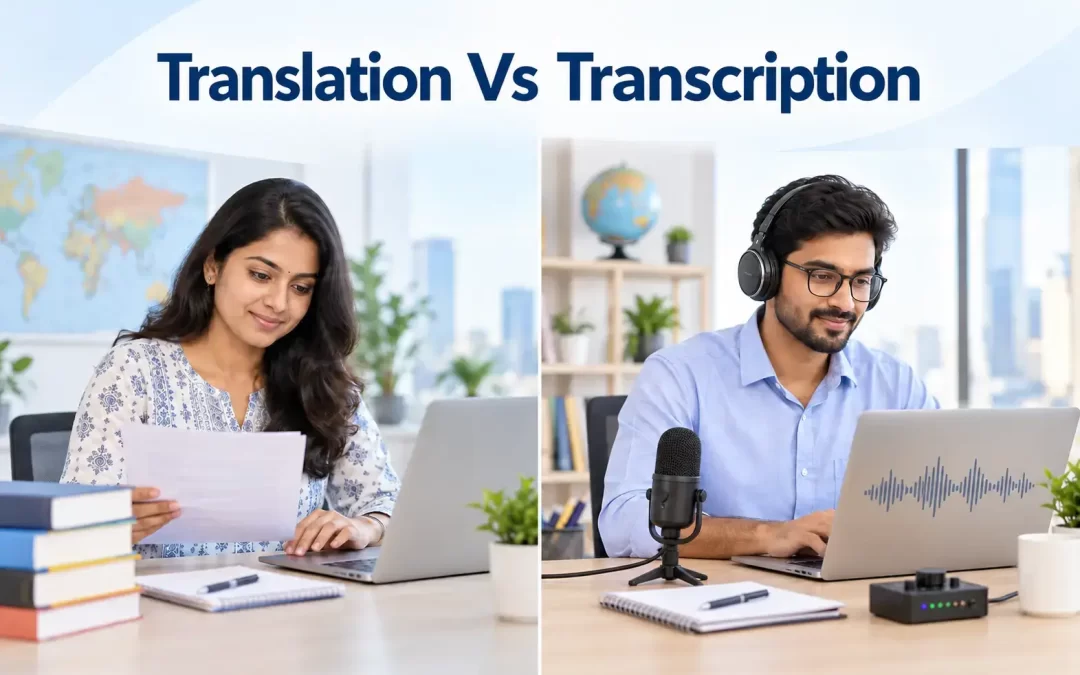
When comparing transcription vs translation for your business content, you face a simple question. Do you only need the spoken words written down? Or do you also need them in another language?
For teams across the USA, UK, the Middle East, and Europe, choosing the wrong service wastes budget. It also causes rework and delivers content you can’t actually use. Let’s break it down in plain language and look at where each service fits in real projects.
Transcription Vs Translation: The Core Difference
Put simply, transcription turns speech into text in the same language. Translation converts text from one language into another. That’s the whole difference, but it has big implications for how you plan content, timelines and cost.
With transcription services, you send an audio or video file and get a written version back in the same language: English meeting notes, Arabic interviews, French focus groups, and so on. No languages change; you’re just moving from spoken to written form.

Effective localization helps businesses connect with diverse audiences by adapting content to local languages, cultures, and preferences.
With translation services, the input is text: a transcript, contract, brochure, training script or web copy. The output is the same content in another language, such as English into German or Arabic into English, ready for readers in a different market.
The confusion usually appears when a recording in one language needs to become written content in another. That’s not one service, it’s two steps: first transcription, then translation.
When Your Business Needs Transcription First
The projects that benefit most from audio transcription all have one thing in common: you need a clean, accurate record of what was said before you decide what to do with it. Think of internal strategy calls, user interviews, board meetings or expert podcasts.
For video teams, video transcription is often the first step toward captions, subtitles or repurposed articles. A word-for-word text version helps editors cut clips, content marketers pull quotes, and legal teams review exactly what was promised in a recorded demo.
If you expect to reuse the same content across channels, a transcript becomes the source for articles, social posts and training materials. That’s why multilingual brands often combine transcription with professional subtitle services so that they can move quickly from a master script to subtitles in multiple languages.
When Translation Is The Primary Need
Think of translation as a reading experience problem, not a format problem. You already have text; your challenge is that part of your audience can’t read it yet. That’s where document translation comes in.
Typical examples include employment contracts, product manuals, marketing brochures and compliance policies. You might have a detailed policy in English that needs to be clear and legally sound in Arabic or French for teams in different regions.
Where content is public-facing, many businesses look for professional translation so terminology, tone and style fit the sector. For example, technical product sheets are better handled by specialists experienced with technical translation services than by general linguists who rarely see engineering content.
Do You Need Multilingual Transcription Or Audio Translation?
Global teams often mix up multilingual transcription with translating spoken content directly. These are not the same workflow, and choosing one over the other affects quality and budget.
With audio translation, a linguist listens to the recording and produces written text in the target language only. There is no full transcript in the original language, which can be fine if you only care about the final translation and don’t need an internal record.
With multilingual transcription, you first create a transcript in the original language, then translate that text. This two-step approach is more transparent: reviewers can check the original transcript, subject matter experts can comment on terminology, and it’s easier to adapt the same transcript into several languages later.
Teams that publish a lot of video often pair multilingual transcripts with expert audio and video transcription workflows, especially when legal, medical or financial topics demand a verifiable record of what was said.
Where Video Translation Services Fit In Your Workflow
Once you start adding multiple languages to video content, the question becomes where video translation services sit in the process. This is where many marketing and training teams in larger organisations lose time.
A practical workflow is: transcribe the source video, translate the transcript, then create subtitles or new voiceover tracks from those scripts. That keeps timing, text and on-screen graphics aligned, and makes it easier to update a single line later without redoing everything.
For campaigns, product explainers or training series, brands often combine translated transcripts with professional voiceover services so on-screen speakers are matched with native voices in each language.
If your video contains technical terms, regulatory references or specialized product language, working with a language partner that already handles professional translation services in 60+ languages will reduce the back-and-forth between your subject matter experts and linguists.
How To Decide: A Simple Checklist For Teams
Instead of treating transcription vs translation as competing options, treat them as tools you combine based on the outcome you want. A short checklist usually clarifies things in minutes.
Transcription Vs Translation: Key Questions To Ask
- Is your source content spoken or written?
- Do you need the output in the same language, another language, or both?
- Will the content be reused across channels (articles, social, training)?
- Do you need a permanent record of the original words for compliance or review?
- How many languages will you need now, and how many might you need later?
If your source is spoken and you need a precise record, you start with transcription. For written sources that the audience cannot read yet, start with translation. If you have recorded speech that must become text in another language, you plan for both.
When To Involve A Transcription Company
Bringing in a specialist transcription company makes the most sense when volume and risk are high. Think weekly stakeholder calls, ongoing research interviews or compliance-sensitive briefings where mishearing a number or date can cause real problems.
Experienced providers use trained linguists, consistent formatting guidelines and secure file handling. For multilingual projects, the same partner can often coordinate transcripts, translations and subtitles, instead of forcing your team to juggle several vendors and file versions.
Balancing Quality, Speed And Budget
Every team has to balance quality with timeline and cost. For short internal recordings, you might accept a rough automatic transcript just to find key points. For external content in multiple languages, that shortcut usually costs more later in editing time and missed nuances.
Where stakes are high, such as legal, medical or technical content, businesses across the USA, UK, Middle East and Europe typically favour human-led workflows with clear review stages. That can mean a transcript, a translation, then professional editing and proofreading before anything goes live.
Conclusion
Choosing between transcription vs translation comes down to one simple decision: do you need spoken words captured accurately, language changed for a new audience, or both in sequence for long-term reuse. Once you map that out, the right workflow is usually obvious.
For organisations in the USA, UK, Middle East and Europe, planning these steps early with a specialist like PSP Languages keeps your content accurate, consistent and ready to publish across formats and markets. If your teams are debating which service to book next, start by listing your actual outputs, then match them to the workflows in this guide.
Frequently Asked Questions
Q1. What is the main difference between transcription and translation services?
Ans: Transcription converts spoken content into written text in the same language, while translation converts written text from one language into another. Many projects, such as recorded interviews for global reports, use both: first transcription, then translation of the transcript.
Q2. Do I always need transcription before translation for audio or video files?
Ans: Not always. If you only need a written version in one new language and don’t require an original-language record, direct audio translation can work. If you need detailed review, multiple languages or long-term reuse, starting with a transcript is usually safer.
Q3. How do businesses in the USA, UK, Middle East and Europe choose between audio translation and multilingual transcription?
Ans: Many teams choose audio translation when they only care about a quick summary or single-language output. They choose multilingual transcription when they need accurate time-coded text for subtitling, compliance checks or translation into several languages over time.
Q4. Can the same provider handle transcription services and translation services?
Ans: Yes, many language service providers handle both transcription services and translation services, coordinating the workflow under one project manager. This helps keep terminology consistent and reduces the risk of errors between separate vendors.
Q5. What types of content most often need video translation services?
Ans: Marketing campaigns, product demos, e-learning modules, webinars and corporate communications are common candidates for video translation services. Teams often combine translated scripts with subtitles or new voiceover audio so viewers in each language get a natural experience.
Q6. When should I work with a professional transcription company instead of using automated tools?
Ans: Automated tools can be useful for quick internal notes, but they struggle with accents, background noise and specialized terminology. A professional transcription company is usually the better choice when recordings are long, confidential, multilingual or tied to legal, medical or technical decisions.