You’ve finished a great video, now the real question hits: voice over vs dubbing — which one will actually work for your markets in the USA, UK, Middle East and Europe?
The wrong choice can make your training course feel flat, your product demo look cheap, or your series impossible to follow. The right choice makes viewers forget they’re watching foreign content and just focus on the story or message.
What Is Voice Over And What Is Dubbing Really?
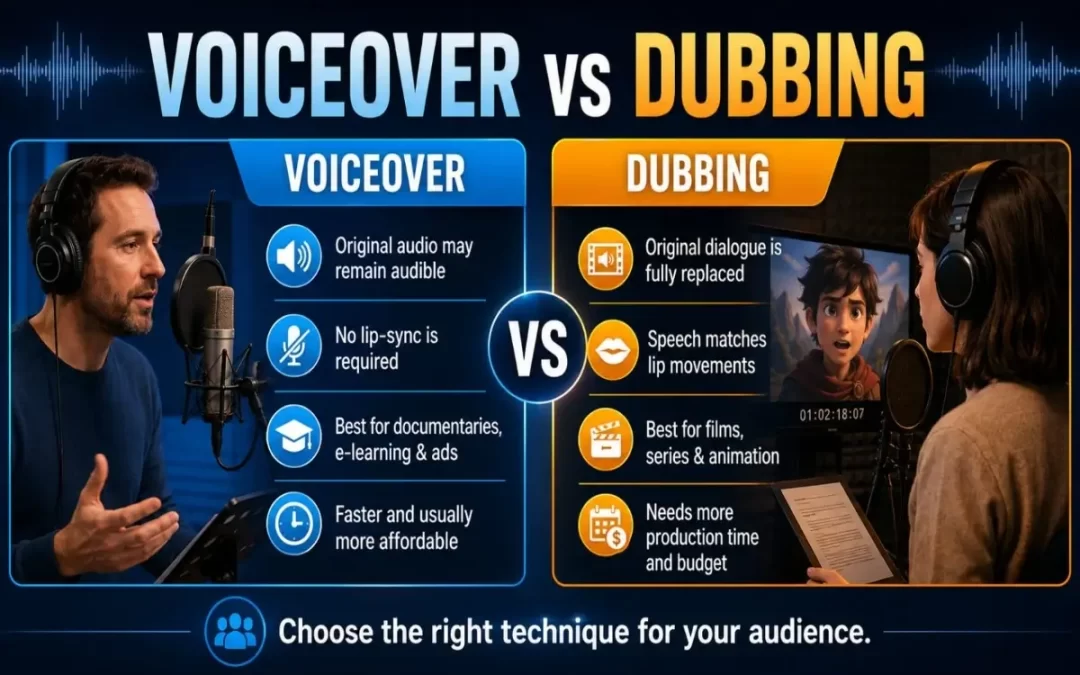
In production meetings people often use “voice over” and “dubbing” as if they mean the same thing, but they don’t. Voice over usually keeps the original audio audible in the background, with a new voice speaking the translated script on top. Dubbing replaces the original dialogue so the new voices sound like the characters themselves.
With voice over services, you typically hear the original speaker for a second or two, then the translated voice fades in above it. This is common in documentaries, interviews and corporate explainers where authenticity of the original speaker still matters.
With dubbing services, the original voice track is muted and new voices are recorded in a studio, often to match mouth movements and timing. This approach is standard for films, drama series, animation and high-end entertainment where immersion matters.
Voice Over Vs Dubbing: The Key Differences That Affect Your Project
Both options are forms of video localization, but they feel very different to the viewer and have different implications for your budget and schedule.
- Viewer experience: Voice over reminds people they’re listening to a translated track. Dubbing, when done well, lets them forget.
- Budget: Voice over usually costs less because it needs fewer actors, less studio time and simpler mixing.
- Timing: Dubbing takes longer due to casting, lip-sync sessions and extra rounds of review.
- Content type: Dubbing suits character-driven content, while voice over is often better for informational content.
For media-heavy brands and streaming platforms using multilingual dubbing, casting and directing become almost as important as the original shoot. For corporate training teams, the lighter workflow of voice over may be a better trade-off.
When Voice Over Works Best
Voice over is usually the smarter choice when the visuals matter more than seeing characters talk. Think software tutorials, HR training, marketing explainers or leadership interviews.

A professional recording studio setup used for voiceover, dubbing, narration, and multilingual audio localization projects.
Show more lines
In these cases, a clear translated narration paired with on-screen graphics does the job nicely. The audience wants clarity more than immersion, so simple video translation services with a strong voice track are often enough.
Voice over also works well when you need to release content in many languages quickly. You can record several languages in parallel, reuse the same pacing template and keep the editing relatively light.
If your budget is tight, voice over lets you prioritize script quality and the right talent instead of spreading resources across a large cast or long studio sessions.
When Voice Over Beats Dubbing On Cost And Speed
Voice over usually wins when you have hundreds of minutes of content and need predictable timelines. For example, large e-learning catalogues or product training libraries are often localized with a single narrator per language and careful planning of localization services.
Because there are fewer voices to manage, edits are simpler. Need to update one compliance line next year? You can call back the same talent for a quick re-record without re-opening an entire dub mix.
When Dubbing Is The Better Choice
Dubbing comes into its own when characters and emotions sit at the heart of your content. If viewers are following a drama, animation, comedy or even a narrative-heavy game trailer, they expect natural dialogue in their own language.
That means foreign language dubbing needs careful casting, direction and sound design. Cutting corners here shows immediately: voices feel disconnected from faces, jokes land late, and dramatic scenes fall flat.
For brands releasing web series or entertainment-style campaigns, strong dubbing can make the difference between “subtitles on in the background” and “binge-watching the full season”. It also matters if your audience watches on mobile, where reading subtitles is harder.
Voice Over Vs Dubbing For USA, UK, Middle East And Europe
Regional preferences really matter. In the USA and UK, audiences are used to subtitles and voice over for non-fiction; dubbing is mostly expected for children’s content and some animation. In parts of the Middle East and Europe, fully dubbed dialogue is normal for mainstream film and television.
If you plan one global strategy, you’ll end up pleasing nobody. Smart teams mix approaches: voice over for corporate and training content, and professional dubbing for series, children’s programming and cinematic campaigns.
How To Decide: A Simple Framework For Your Next Project
To cut through the “voice over vs dubbing” debate, focus on five questions. The answers are usually enough to make the choice obvious.
- What is the goal? Teach, sell, inspire, or entertain?
- Who is the audience? Age, viewing habits and language comfort all matter.
- Where will it be watched? TV, streaming, mobile, in-office training?
- How long is the content? A 30-second spot is different from a 10-hour course.
- What is the realistic budget and deadline? Not the ideal one, the real one.
For complex content mixes, some organisations work with a single partner across professional voiceover services, subtitling and translation, so they can design a consistent multilingual strategy instead of making ad-hoc decisions per video.
If you have one flagship video that must impress senior stakeholders, you may decide dubbing is worth the extra investment even if the rest of the series uses voice over.
Combining Dubbing, Voice Over And Subtitles
You don’t have to choose one method forever. Many teams combine a primary audio format with on-screen captions or subtitles to cover different viewer preferences.
For example, an internal training video might use voice over as the main track, plus professional subtitle services for silent viewing at work. A web series might offer both dubbed and original-language versions to suit different habits in Europe and the Middle East.
Production Workflow: What Changes Between Voice Over And Dubbing?
From the outside, both options look similar: you send a script, receive audio, approve it, then launch. Inside the studio, the workflows diverge.
With voice over, the team usually adapts the translated script for timing, books one or two voices per language and records in longer takes. The focus is on clarity and consistent tone across all videos, supported by strong professional translation services.
With dubbing, you’re looking at casting multiple actors, adapting lines for lip-sync, recording scene by scene and doing more detailed mixing. Direction becomes critical to keep performances aligned with the original intent.
Whichever route you choose, quality control on terminology and brand tone is non-negotiable. That’s where teams often pair audio work with professional editing services or rigorous script review before anyone steps into the booth.
How Voice Over Vs Dubbing Fits Into Wider Localization
Audio is only one part of your localization plan. On-screen text, graphics, product names and even gestures sometimes need adapting too.
Brands that already invest in multilingual voice-over strategy for their global content usually get better results because they think about voice casting, terminology and audience expectations as a package, not as separate tasks.
For content-heavy platforms, combining solid audio localization with consistent on-screen text and smart use of translation memory tools keeps quality high across dozens of languages without constant rework.
Common Mistakes To Avoid With Voice Over And Dubbing
Most problems don’t come from choosing the “wrong” method; they come from poor planning. A few recurring mistakes show up across media, training and marketing teams.
- Writing the script too late: If you lock the video before adapting the script, timing becomes a headache.
- Skipping cultural review: Jokes, references and idioms might not travel well, especially in multilingual voice tracks.
- Underestimating approvals: Multiple regional teams mean more feedback. Build that into your schedule.
- Choosing talent only on price: Cheap voices sound cheap. Viewers hear it immediately.
Teams that already work with dedicated media translation specialists tend to avoid these issues because they treat localization as a production discipline, not an afterthought.
For marketing-led content, it can also be worth exploring approaches such as creative transcreation for key lines and taglines, then building the voice track from that refined script.
Conclusion
Choosing between voice over vs dubbing comes down to what your viewers expect, how they watch content, and how much you’re ready to invest in immersion versus speed. Different answers make sense for training, drama, explainers and campaigns across the USA, UK, Middle East and Europe.
If you want a partner who can think through those trade-offs with you and build a realistic audio localization plan, PSP Languages can help you match the right method to each project and keep your global content strategy consistent.
Frequently Asked Questions
Q1. Is voice over or dubbing better for corporate training videos?
Ans: For most corporate training programmes, voice over is more practical. It lets you keep costs controlled, move quickly across several languages and update modules without re-recording an entire cast. Dubbing usually only makes sense if the training is very scenario-based or highly scripted like a drama.
Q2. How do I choose between voice over vs dubbing for marketing content?
Ans: Start with the role of the video in your funnel. If it’s a brand film or emotional campaign, dubbing often lands better because viewers connect more with characters speaking in their language. For explainers or product walk-through, clear narration through voice over normally delivers a better return on your localization budget.
Q3. What are the main cost drivers for dubbing services?
Ans: The biggest cost factors are casting multiple actors, studio time per language and the extra mixing and review passes needed to align performances. Complex projects might need directors and more detailed QC. You gain a more immersive result, but it demands more planning and budget compared with a straightforward voice over.
Q4. Can I mix subtitles with voice over or dubbing in the same project?
Ans: Yes, many teams do this. For example, you might add multilingual subtitles to dubbed content to support viewers watching with the sound off, or use subtitles to complement a simple voice over track. The key is to plan the full accessibility and localization experience from the start instead of adding each layer reactively.
Q5. Do preferences for dubbing vs voice over differ between USA, UK, Middle East and Europe?
Ans: They do. Audiences in the USA and UK are more comfortable with subtitles and voice over for factual content, while many viewers in the Middle East and Europe expect full dubbing for mainstream entertainment. When in doubt, talk to local teams and review how similar content is distributed in each region.
Q6. When should I involve a language partner in my video production process?
Ans: Ideally, speak to your language partner while scripts are still in draft. That gives them time to flag issues that will cause problems for multilingual voice over, dubbing or subtitles later. Early involvement usually means fewer re-edits, more accurate timing and a smoother localization process for every language.